
It’s Getting Late Early

This is the fourth time I’ve written about James Talarico. This time, the math has changed.
On Tuesday, Donald Trump endorsed Ken Paxton for the United States Senate. He did it one week before the May 26 runoff — late enough to have enjoyed the spectacle of John Cornyn’s self-abasement, and early enough to potentially reshape the outcome. The endorsement was accompanied by the language Trump reserves for vassals: “a true MAGA Warrior who has ALWAYS delivered for Texas.”
That sentence should be read slowly. Because what Ken Paxton has delivered for Texas — and I mean delivered with documented, adjudicated, bipartisan specificity — includes the following: a felony securities fraud indictment that lingered for nearly a decade before being settled with a plea deal; an impeachment by his own Republican-controlled Texas House on twenty articles of misconduct, including allegations that he abused his office to benefit a political donor; credible accusations that the same donor hired Paxton’s mistress to facilitate secret meetings; a whistleblower retaliation case his office lost; a federal corruption investigation; and a divorce filed by his own wife — a sitting state senator — on what she publicly called “biblical grounds,” citing adultery. Angela Paxton’s statement was not ambiguous: “I believe marriage is a sacred covenant and I have earnestly pursued reconciliation. But in light of recent discoveries, I do not believe that it honors God or is loving to myself, my children, or Ken to remain in the marriage.”
That is the man Donald Trump just called a “fighter” who “knows how to WIN.”
And this is the man who may now be the Republican nominee for United States Senate from Texas.
If you are James Talarico, what just happened on Tuesday is the clearest opening a Texas Democrat has been handed in a generation. If you are a Black voter in Dallas County, what just happened on Tuesday is the most important reason you’ve had since March to pay attention.
And if you are someone who has been saying — as I have, three times now — that this campaign needs to get serious about earning the Black vote, Tuesday just turned that request into an ultimatum.
The Cornyn Humiliation
Let us take a moment to appreciate the sheer theatrical absurdity of what just happened to John Cornyn.
Here is a man who has served four terms in the United States Senate. Who chaired the Senate Republican Conference. Who was, until recently, the most powerful Republican in Texas. And in the final weeks of a runoff that will determine whether he continues to hold his seat, Cornyn introduced legislation — the I-47 Future Interstate Act — to rename US Highway 287, a 1,800-mile corridor stretching from Port Arthur, Texas, to Choteau, Montana, as the “Trump Interstate.”
Not because Texas needs another interstate designation. Not because US-287 is in disrepair. But because John Cornyn needed Donald Trump to notice him.
“Texas is Trump Country,” Cornyn said in the press release, “and this bill cements that legacy.”
One week later, Trump endorsed Ken Paxton.
The bill had, as multiple outlets noted, “little to no chance of passing.” It was not a policy proposal. It was a tribute. A love letter written in asphalt, 1,800 miles long, from a man who had been told — by the very person the highway was meant to honor — that his loyalty came too late and was too thin. Trump’s actual words: “John Cornyn is a good man, and I worked well with him, but he was not supportive of me when things were tough.”
This is a man who voted to confirm every one of Trump’s Supreme Court justices. Who helped shepherd the confirmation of more than 200 federal judges. Who, by any standard of institutional Republican loyalty, delivered. But he also supported a bipartisan gun safety bill. He once said, in 2023, that Trump’s time “has passed him by.” And those sins — pragmatism and a moment of honest assessment — were unforgivable.
So Cornyn tried the highway. And it didn’t work.
What happened to John Cornyn is not merely embarrassing. It is instructive. It tells you everything you need to know about the Republican Party’s internal logic: loyalty is never enough; only fealty satisfies. And the distance between the two is the distance between a senator who served his party faithfully for twenty years and a man willing to name a highway after a president who still wouldn’t return the favor.
There is a sermon in that somewhere. But I’ll spare you. The parable tells itself.
The Gift and the Danger
Ronell Smith — the former Southlake City Council member whose recent Dallas Morning News column deserves wider attention — laid out the structural argument with precision. Trump found it easy to move against Cornyn, Smith wrote, because the incumbent failed multiple purity tests. The endorsement “is less a verdict on Paxton’s strength than on Cornyn’s insufficient fealty.” And Smith identified the deeper architecture: “a party yields to the appetites of its ideological vanguard, internal logic renders correction impossible, and the general electorate arrives to collect the debt in the following cycle.”
Smith cited the Kamala Harris precedent — a party that elevated a nominee despite clear evidence of thin national appeal, because internal commitments made correction impossible. And he warned Republicans that the same structural failure is now operating in their own house.
The Texas Southern University poll he referenced has Talarico in a dead heat with Paxton — both at 45%, with 8% undecided. Against Cornyn, Talarico trails by a single point. The difference is not large, but the direction is significant: Paxton is the weaker general election opponent. And now Trump has thrown his weight behind the weaker candidate.
That is a gift.
But gifts spoil when they’re left on the counter.
What I’ve Said Before — and Why It’s Louder Now
In March, I said James Talarico would have my vote — and spelled out exactly what it would take to earn the votes of Black Texans who will decide whether that vote matters. I named the precincts. The neighborhoods. The consultants. The media outlets. The civic infrastructure. The churches. The work.
In April, I tried to write the endorsement and couldn’t — not because I don’t support Talarico, but because the deeper problem surfaced: a democracy that converts opponents into enemies, a political culture that wants kings instead of citizens, and a candidate class that keeps asking us to believe in them when the real question is whether they believe in us.
In May, Politico confirmed what many of us had been saying for weeks: congregants at Friendship-West Baptist Church — Jasmine Crockett’s home church, one of the most politically significant Black congregations in Texas, a thirteen-thousand-member body pastored by Dr. Frederick Haynes III, the likely successor for Crockett’s congressional seat — were still waiting to hear from James Talarico. Not from surrogates. From him.
“Come and make the ask,” one congregant said. “Come and try to earn the vote.”
That was the state of play before Tuesday.
Now the landscape has shifted beneath everyone’s feet. Trump has endorsed the most scandal-plagued statewide official in Texas. The Republican primary is almost certainly going to produce a nominee whose personal and professional record would disqualify a city council candidate in most jurisdictions. The general election contrast — a young, faith-driven state legislator against a man whose own wife left him on biblical grounds for adultery, who was impeached by his own party, who settled a securities fraud case, whose office lost a whistleblower retaliation lawsuit — is almost too clean to be real.
And into that contrast walks James Talarico, with the clearest path a Texas Democrat has had since Ann Richards.
But a path is not a destination. And a clear lane means nothing if the vehicle isn’t fueled.
Gradualism Is Over
Let me say plainly what this moment requires.
Talarico has done some of the work. He has visited some Black churches. He went to Prairie View A&M. He block-walked in DeSoto. He held a clergy roundtable. All good. All noted. All insufficient.
What Colin Allred said in the Politico piece remains the truest thing anyone has said about this campaign: “He needs to show comfort in Black spaces and Black communities. There’s just no substitute for it.”
There is no substitute for it.
And now — now that Trump has handed the Texas GOP its most compromised nominee in modern memory — gradualism is no longer an option. This is not the time for “love to” or “soon” or “a few messages” exchanged with Jasmine Crockett. This is the time for a full-scale, sustained, relational offensive in the communities that will decide whether Talarico’s candidacy becomes a historic upset or another Texas Democratic near-miss that gets filed away with Beto and Wendy Davis and every other campaign that came close and didn’t finish.
What does that look like? I’ve said it before. I’ll say it again, because the list doesn’t change just because the opportunity got bigger:
Invest in Black political consultants — now, not in September. Advertise in Black media — Texas Metro News, The Dallas Examiner, K104, gospel and talk radio — now, not in October. Sit for interviews with Black journalists who know the landscape. Meet with Black leadership beyond the usual suspects — neighborhood association presidents, civic organizers, nonprofit leaders, educators, small-business owners, fraternity and sorority leaders, precinct chairs. Deploy surrogates who have real relationships in the communities where turnout is built. Show up physically — repeatedly — in Pleasant Grove, South Dallas, Cedar Crest, Oak Cliff, Lancaster, DeSoto, Glenn Heights. Speak clearly to the issues Black voters cite: criminal justice, economic mobility, education, housing, health access, and voting rights.
And sit down with Jasmine Crockett. Do not exchange messages. Sit down. Do the work of repair. Because a significant portion of the Black electorate in Dallas County supported Crockett because they believed in her. Many still believe the primary was distorted by forces Talarico may not have controlled but certainly benefited from. A concession statement did not heal that. What heals it is Crockett standing next to Talarico in the pulpit of Friendship-West and telling her people she trusts him. That has not happened. And until it does, a meaningful portion of the electorate will remain exactly where they are: willing to vote, but waiting for a reason to get in the car.
The Commencement and the Construction Site
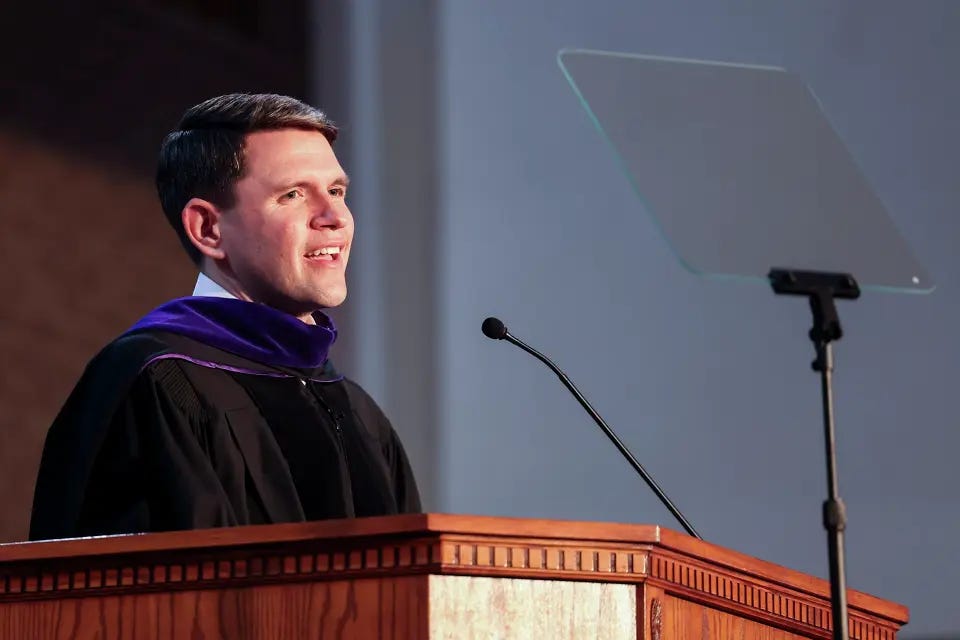
Give credit where it’s due. Talarico’s commencement address at Paul Quinn College was the best speech of his campaign — and I say that as someone who listens to speeches for a living.
He stood in Highland Hills, at an HBCU founded by Black preachers holding classes in church basements seven years after emancipation, and he preached. Not performed — preached. He quoted Langston Hughes: “I am so tired of waiting, aren’t you? / For the world to become good and beautiful and kind. / Let us take a knife and cut the world in two / to see what worms are eating at the rind.” He invoked bell hooks on the resurrection of a culture dead to love. He cited Howard Thurman: “Don’t ask what the world needs. Ask what makes you come alive and go do it.” He called the crisis we’re living through “at its root a spiritual crisis” that “will require a spiritual solution.” He told those graduates — most of them Black, most of them from neighborhoods not unlike the ones I’ve been naming in this series — that “the stones the builders rejected will be the cornerstone.”
That is a man who can stand in a Black institution and speak its language with conviction. That’s not nothing. It is, in fact, the thing many skeptics said he couldn’t do. And he did it well.
But here is the question the commencement doesn’t answer.
Less than three miles from Paul Quinn’s campus, on Martin Luther King Jr. Boulevard in the heart of zip code 75215, the Forest Theater is rising from the dead. Built in 1949 by Karl Hoblitzelle, the Forest once hosted Tina Turner, Prince, B.B. King, Erykah Badu, Dave Chappelle, and Gladys Knight. It closed over fifteen years ago. The building deteriorated to three walls and not much of a roof. It was nearly demolished to make way for a gas station.
Then Elizabeth Wattley and Forest Forward decided otherwise.
What Wattley has built is not a renovation. It is a revolution from below — the same phrase Talarico borrowed from Dr. Michael Sorrell in his commencement speech. Forest Forward’s capital campaign has grown to $85 million in public and private funding. The project will produce a 66,000-square-foot complex: a 1,000-seat performance hall, a 200-seat studio theater, a 13,000-square-foot arts education hub, a recording studio, a rooftop terrace with unobstructed views of the downtown skyline and Fair Park. Construction has generated over 1,100 jobs and nearly $70 million in worker earnings. The grand opening is projected for November 2026 — the same month as the general election.
But the Forest Theater is more than a building. It is an anchor for a comprehensive neighborhood revitalization — mixed-income housing, infrastructure upgrades to century-old pipes, a partnership with Dallas ISD to transform the MLK Learning Center into an arts academy, and a deliberate strategy to de-concentrate poverty in a zip code where the median household income is $39,500, and the life expectancy is sixty-seven years — the lowest in Dallas County.
There was a community meeting there not long ago to inform neighbors and show them the progress made prior to the grand opening in November. There may have been a hundred or so people from the area there. This is the civic life that already exists in the neighborhoods where I’ve been saying Talarico needs to show up. This is not ornamental. This is the engine. While campaigns debate outreach strategies and consultants draft engagement memos, Elizabeth Wattley is building the physical infrastructure of community renewal in the same zip code where turnout runs in the single digits.
Talarico can preach at Paul Quinn. That’s the easy room — a graduation crowd, a captive audience, a setting that rewards oratory. The harder room is the one where Wattley and the people of 75215 are doing the unglamorous, multi-year work of rebuilding their own neighborhood from the inside out. The harder room is Friendship-West. The harder room is the neighborhood association meeting in Cedar Crest. The harder room is the precinct chair’s living room in Lancaster.
You spoke beautifully at Paul Quinn about “a revolution from below.” The revolution is already happening, James. The question is whether you’re willing to join it — not as the keynote speaker, but as a participant. Not to deliver a sermon, but to sit in the pew.
The Contradiction That Writes Itself
Here is what makes this moment different from the last three columns.
Before Tuesday, the case for urgency was theoretical — a matter of probabilities, polling, and political structure. Now it’s concrete. Because now we know who the opponent is likely to be. And now we can say what the contrast actually looks like.
Ken Paxton told Texans that the Uvalde massacre — nineteen children and two teachers — was “God’s plan.” He ran the attorney general’s office as a personal fiefdom, using its power to benefit a donor who allegedly hired his mistress. His own Republican colleagues in the Texas House voted 121-23 to impeach him. His wife filed for divorce, citing adultery. He settled a felony securities fraud case. His office lost a whistleblower retaliation suit. He tried to overturn the 2020 presidential election results, earning a complaint from the State Bar of Texas.
And the man who was supposed to run against him — the four-term United States Senator who voted with Trump’s agenda overwhelmingly, who confirmed his justices, who chaired his conference — was deemed insufficiently loyal. The senator tried to earn the endorsement by proposing to name 1,800 miles of American highway after the president. The president took the tribute, said thank you, and endorsed the other guy.
That is the Republican Party in Texas right now. That is what Talarico is running against.
If a Democrat cannot draw a clear, compelling contrast with that record — not in theory, but in the living rooms and sanctuaries and barbershops and precinct meetings where votes are actually earned — then the problem is not the electorate. The problem is the campaign.
The Taylor Rehmet Lesson
Ronell Smith’s column offered one more data point that deserves attention. Taylor Rehmet’s upset of Leigh Wambsganss in deep-red Texas Senate District 9 — a district Trump carried by more than 17 points in 2024 — was proof of concept. Rehmet, an Air Force veteran and aircraft mechanic, spoke credibly to working Texans while his opponent carried the liabilities of a candidate tailor-made for a primary electorate but unsuitable for a general one.
The principle is transferable: intensity is cheap; strength must be earned. The loudest voters can deliver a primary. They are a liability when defining a future. If Paxton wins the runoff on May 26, Democrats will face a general election opponent who is the embodiment of that principle — a man elevated by the intensity of a partisan base, carrying every liability that general electorates punish.
But Rehmet didn’t win by default. He won because he did the work. He showed up. He spoke to people where they were. He earned trust, precinct by precinct, conversation by conversation. The contrast was real, but the contrast alone didn’t vote. People voted. And people voted because someone asked them to.
Go
You know what the Republicans just handed you. You can see the contradictions — a party that rewards corruption over competence, fealty over fidelity, a man whose own wife left him on biblical grounds over a senator who named a highway after the king and still wasn’t deemed loyal enough. Those contradictions don’t need a focus group. They need a messenger. And the messenger needs to be standing in the rooms where the votes live.
The voters have not moved. They are where they have always been — in the same churches, neighborhoods, precincts, and addresses. They are not hard to find. They are waiting to be asked.
You probably think you have time. And maybe you do. The runoff is May 26. The general is in November. The calendar looks long from where you’re sitting.
But I’ll tell you what it looks like from Pleasant Grove. From South Dallas. From Cedar Crest. From the pews of Friendship-West. It looks like every other campaign that said the right things, showed up late, and then wondered in November why the turnout wasn’t there.
I’ll say it again. Yogi Berra had it right: “It’s getting late early.”
The door is open, James. Wider than it’s ever been.
We hope you walk through it…soon.