
We Lost More Than a War
On the difference between sacrifice and suffering and what the Iran war took from the American soul

War is never merely the clash of armies. Clausewitz, the nineteenth-century Prussian general and military theorist, taught that war is always the servant of a political aim, and that it is won or lost according to whether that aim is achieved. Nearly two centuries later, General Colin Powell translated that old wisdom into a set of questions a republic ought to answer before it sends its sons and daughters into danger: Is a vital national security interest threatened? Is the objective clear and attainable? Have the risks and costs been fully and frankly weighed? Have all nonviolent means been exhausted? Is there a plausible exit strategy? Have the consequences been considered? Does the action have the support of the American people and genuine international backing? Those were not academic questions. They were the guardrails meant to keep power from mistaking motion for purpose, and violence for strategy. It would have served us well if either the Secretary of Defense or the Commander in Chief had kept those lessons close before drawing the country into the military misadventure in Iran.
That failure became plain in the war’s final scene. When the President left the palace at Versailles, having signed his name to the agreement that ended the war with Iran, he was asked what it contained. He conceded that no one really knew what the thing contained, even as he pronounced it very strong. And then, as if describing the return policy on a household appliance, he allowed that if it displeased him, the country could always “go back to shooting at them, dropping bombs.”
I have been turning that sentence over for days. Not the boast; we are accustomed to the boasts. It is the other part that lingers: the ease of it. The casualness with which a man can stand in the courtyard of a French king and speak of dropping bombs on a nation of ninety million people as though the matter were no more grave than returning a coat that did not fit.
That ease is the subject of this essay, because a country can survive a bad war more readily than it can survive the moral numbness that makes one possible. What it cannot so easily survive is the loss of its power to distinguish a war worthy of its dead from a war that merely produces them.
Eventually, the President settled on four objectives for this war of his own choosing. First: end Iran’s nuclear program and ensure it never obtains a weapon. Left unachieved. Iran keeps its program, its enrichment continues, and its stockpile of highly enriched uranium remains in the country, with its disposition pushed into later talks and no verification regime secured in the agreement.
Second: end Iran’s ballistic missile program. Left unachieved. The missiles are untouched by the deal, and the President himself allowed that Iran has the right to develop them.
Third: end Iran’s support for Hezbollah and its other regional proxies. Left unachieved. Iran is not required to dismantle its proxy network, and the Lebanon clause restrains Israeli operations against Hezbollah rather than Iranian support for it.
Fourth: topple the Iranian government, the regime-change aim the President floated when the war’s purpose began to drift. Left unachieved. The Supreme Leader was killed in the opening strikes, but power passed to his son; the government survived, and survived intact enough to sit down and sign.
We are told we won. Iran is told it won. Perhaps that is the first sign that victory has become a word too easily spent. A war may end with signatures and flags and men at microphones insisting that history has bent their way; but victory, if the word still means anything, must be measured against the purpose for which the dead were sent forward. By that measure, the ground beneath this triumph is unstable. So let us do the thing my old paper trained me to do: place the evidence next to itself, refuse the comfort of slogans, and ask what was gained, what was lost, and whether the exchange deserves the name victory at all.
Two roads to the same table
There was an earlier deal. In 2015, after nearly two years of exhausting and unglamorous negotiation, the United States and five other nations bound Iran’s nuclear program in writing. Iran shipped out or diluted the vast bulk of its enriched uranium. Two-thirds of its centrifuges went silent. International inspectors stood inside its facilities and counted. If Iran chose to run for a bomb, the time required to build one was stretched from a few months to a year. The agreement was imperfect; its critics were not wrong to say so. But we should be clear about the kind of imperfection it contained. Every serious complaint belonged to one category: we might have gotten more. None of its flaws was written in blood. No mother lost a child to the Iran deal of 2015.
The current President spent years denouncing that deal, and in 2018 he tore it up. Once unbound, Iran climbed: to a stockpile enriched to sixty percent, a short step from weapons-grade, and to the very danger the war would later be sold as necessary to prevent. So before we count the costs, we have to tell the truth about the road. It was not forced upon us. We helped pave it ourselves, by demolishing the patience that had been working.
Then, on the twenty-eighth of February, we went to war — we and Israel, largely alone: without a broad coalition, without the United Nations, and without a vote of the Congress the Constitution charges with the decision. Our own Director of National Intelligence had testified that Iran was not building a weapon — a judgment the intelligence community had not reversed by the time the bombs fell. Two days before the first bomb fell, in the third round of Omani-mediated talks in Geneva, Iran had offered to dilute the very stockpile we said we feared, under international monitoring. The facts were before us. The off-ramp was visible. We dropped the bombs anyway.
The conflict lasted 100 days. The Strait of Hormuz closed, and a fifth of the world’s oil sat hostage. Gasoline crossed four dollars. Flights were grounded across Europe. The global economy teetered on the edge of recession.
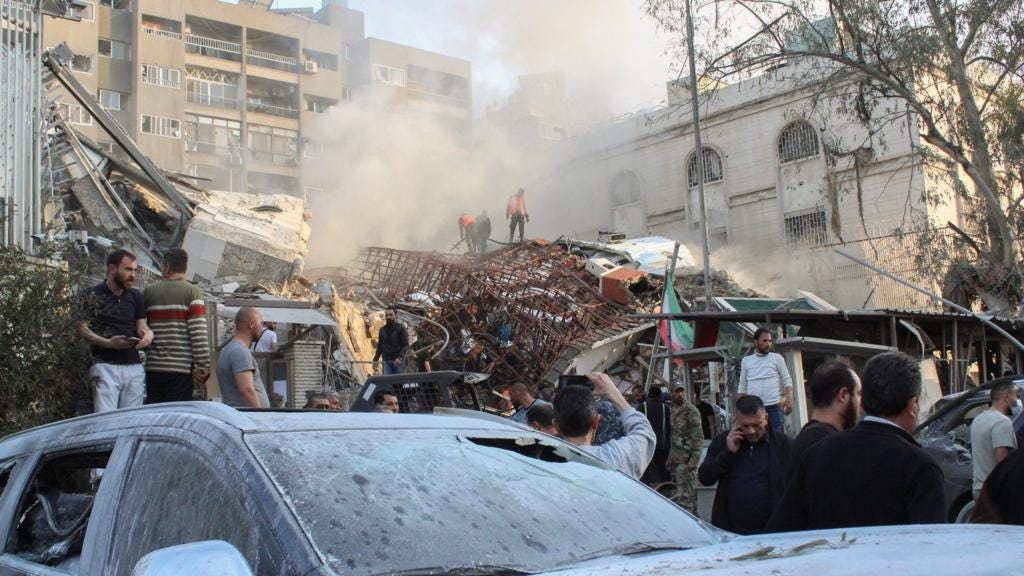
And then there were the dead: thousands across Iran, Lebanon, Israel, the Gulf, and our own ranks. The Lebanese health ministry counted more than a million and a half people driven from their homes in the south. Among the Iranian dead, by a preliminary investigation of our own military, were roughly a hundred and seventy-five girls and their teachers at a school in Minab. Thirteen Americans in uniform did not come home.
And what did all of it buy? A deal weaker than the one we destroyed. Iran keeps its nuclear program, its enrichment, and its stockpile, with the disposition of that stockpile pushed into later talks. It keeps its missiles; the President allowed that it has every right to them. It keeps its proxies. Its government did not fall. Power passed from father to son, and the regime survived intact enough to sit down and sign. We returned a portion of Iran’s own frozen money, as we had in 2015, and then went further than 2015 ever dared: pledging to assemble at least three hundred billion dollars to rebuild the country we had spent three months destroying. We will marshal a fortune to raise Iran’s refineries and airports from the rubble. We have not marshaled such a fortune to raise the neighborhoods of our own cities from theirs.
Both roads ended at the same table, before the same nuclear file. One arrived after twenty months of negotiation, with no one dead and with a stronger hand. The other arrived after a hundred days of war, over thousands of graves and with a weaker one. And then, having reached that weaker bargain, it promised that if the deal disappointed, the remedy would be the same remedy again: more bombs, more graves, more suffering called strategy.
Sacrifice and suffering
This is about all any ledger can do: count the dead, name the broken cities, tally the oil shock and the cost of rebuilding. But there are losses a ledger cannot measure, and I speak here as a preacher, with the heart of a pastor and prophetic concern.
Americans know how to sacrifice. We have proven it in our history, sometimes nobly and sometimes tragically, but never cheaply. When Pearl Harbor was bombed, a generation rose and gave itself to a cause large enough to bear the weight of its giving. We have sacrificed even in the defense of others; that was the better angel that first carried us toward Vietnam, before that war hardened into something aimless and devouring, and before a preacher named King came home and told the country what conscience required him to say.
But sacrifice and suffering are not the same thing. A free people forgets many things at its peril; it forgets this one at the peril of its soul.
Sacrifice is offered. It is chosen, laid down toward an end worthy of the laying down. In the Christian imagination, it belongs to the altar and finally to the cross: a life given freely, for love, for neighbor, for a truth larger than the self. Suffering is different. Suffering can be imposed. It can be inflicted by those who will not bear it themselves. Pain alone does not make an offering holy. What gives sacrifice its dignity is the justice of the end it serves.
This war had no such end. It failed the old moral tests by which Christians and citizens have tried to restrain the appetite for violence: just cause, lawful authority, last resort, proportion. Because it had no just end, the cost it demanded cannot be lifted into the dignity of sacrifice by rhetoric after the fact. It remains what it was from the beginning: suffering. Suffering dressed in the language of sacrifice. It is the quiet retrofitting of sacred language onto decisions made for smaller reasons. Support the troops. For our security. Necessary force. The words are not always false; that is what makes them dangerous. They become false when they are asked to bless profane motives, when the vocabulary of honor is laid over affliction to make it seem consecrated.
The cruelty of that counterfeit falls first on those who actually offered themselves. The thirteen who wore our uniform did not merely suffer. They sacrificed. They entered the covenant every soldier enters: that if the nation asks for life, the nation will have searched its conscience first. If the cause proves false, their offering does not become less holy. Their sacrifice was real; the war made waste of it.
And the girls in Minab, the families driven from southern Lebanon, the dead who never carried our flag or chose our quarrel — they were not even granted the soldier’s covenant. Their suffering was imposed, and it was imposed in our name.
The answer, and why it does not hold
I can hear the answer, and I won’t pretend it doesn’t matter. ‘It is only an interim deal’, its defenders will say; ‘the final terms are not yet written’. ‘The bombs degraded Iran’s program in ways inspectors never could’. ‘We killed the man at the top. We ended the war before it became a quagmire’. And ‘the old agreement had flaws of its own’.
All of that’s true. But the fact remains: if the bombs destroyed the program, why did we need sixty more days of negotiation to constrain it? If the threat had been removed, why did the agreement leave enrichment alive? A nation cannot say, in the same breath, that danger has been ended, and that danger must still be bargained down. We killed a supreme leader and received his son. We ended a war we did not need to begin, on terms weaker than those we once held without firing a shot. Knowing when to stop can be wisdom, but only when stopping is joined to truth. To stop short of every goal you named, after the graves, after the oil shock, after the children and the soldiers and the cities, is not prudence. It is the war confessing itself.
What we lost
So I will tell you what we lost, because it was more than a war.
The soul of a republic — the thing that keeps it a republic and not an empire — is its capacity to tell sacrifice from suffering, and its refusal to let the latter be sold to it as the former. It is the discipline to ask, before a single life is spent, whether the end is worthy of the spending. It is the honesty to read our own intelligence without bending it into prophecy. It is the humility to bring the question of war before the people’s representatives, and not surrender it to one man’s appetite, one man’s fear, or one man’s sentence spoken in a foreign courtyard.
That capacity is what we lost. Not all at once. Not in one battle. We lost it in a habit of soul: in the ease of the man at Versailles, and in our own willingness to hear the word sacrifice and ask no further question. A nation that can no longer tell the offered from the imposed has misplaced the organ by which it knows right from wrong.
The old prophets had a word for power that is loud and hollow: weighed in the balance and found wanting. We have been weighed. The bombs were not the proof of strength; they were the proof of the absence of strength. Strength would have kept patience when patience was working. Strength would have told the truth about the threat. Strength would have trusted the people with the decision. What we showed the world instead was a great and frightened power reaching for force because it had lost the courage, and the honesty, to reach for anything harder.
We can recover what we lost, but not by pretending we did not lose it. The first act of keeping a soul is confession. So let this be the confession: the dead were not honored by the policy that sent them. The soldiers sacrificed; the war made waste of their sacrifice. The civilians suffered; we made their suffering answer to our name. And then we asked the country to call the whole thing victory.
Clausewitz warned that war must answer to its political purpose. Powell warned that a republic must know its purpose, its cost, its exit, and its conscience before the first shot is fired. We ignored both warnings, and the result is before us: objectives unmet, costs multiplied, authority evaded, sacrifice confused with suffering, and a weaker bargain purchased with blood. May we learn again to know the difference. It is the difference between military strategy and mindless violence. It is the difference between a republic and a regime. It is, in the end, the difference between telling the truth and telling ourselves a story about brave men and women whose lives may have been lost rather than given.